feature · movies
The Mosquito Bowl True Story Explained — What's Historical Fact vs. Bissinger's Book vs. Peter Berg's Film
Netflix's The Mosquito Bowl is based on a real 1944 Marine football game and Buzz Bissinger's nonfiction book. Here's what's documented history, what's Bissinger's narrative framing, and what the film itself dramatizes.
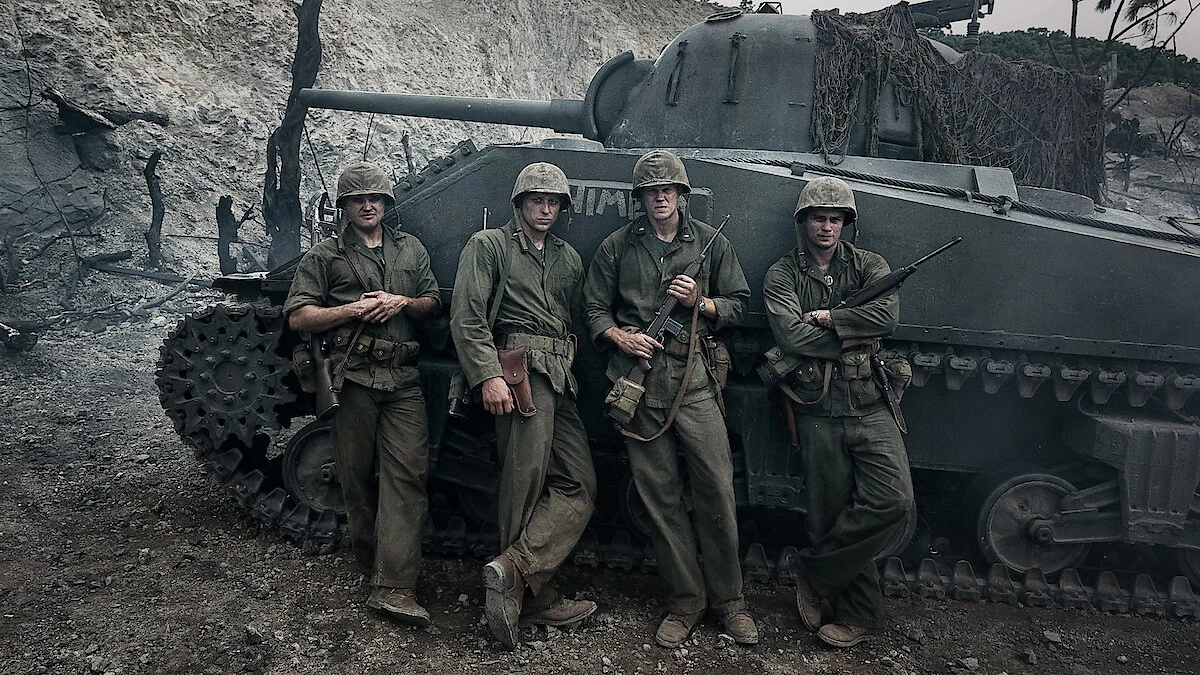
The Mosquito Bowl is a real event — a football game played by Marines on Guadalcanal in 1944, days before many of them shipped out to Okinawa, where a number of them died. Netflix’s film, directed by Peter Berg, is based on Buzz Bissinger’s nonfiction book of the same events. Here’s where the documented history ends and the storytelling begins, at each layer.
CONFIRMED BY NETFLIX
- Directed by Peter Berg (Friday Night Lights, Lone Survivor), written by Berg and Mark L. Smith
- Based on Buzz Bissinger’s book The Mosquito Bowl: A Game of Life and Death in World War II
- Starring Nicholas Galitzine, Bill Skarsgård, Ray Nicholson and Tom Francis as four of the college football players who enlisted
- U.S. theatrical release October 30, 2026, streaming on Netflix November 25, 2026
- Produced by Film 44 and Imagine Entertainment
Layer One: What Actually Happened in 1944
The historical record is well-documented and predates both the book and the film. On Christmas Eve 1944, 65 U.S. Marines from the 4th and 29th Marine Regiments, 6th Marine Division — many of them former college football players, including several who’d played at major programs before enlisting — played an unofficial football game on a field on Guadalcanal, nicknamed the “Mosquito Bowl” for the island’s insect population. Within months, many of the men who played that day were sent into the Battle of Okinawa, one of the bloodiest campaigns of the Pacific War, and a significant number of them were killed. That the game happened, who organized it, and the fact that a disproportionate number of its players died shortly after at Okinawa are all matters of historical record, not narrative invention.
Layer Two: Bissinger’s Book and Its Framing
Buzz Bissinger — who previously wrote Friday Night Lights, also later adapted by projects involving Berg — built his book around a small number of individual players, reconstructing their personal stories, friendships and final months through research and interviews with surviving family members. That’s where the “based on a true story” label starts to involve authorial choices: which players to focus on, how their personalities and relationships are characterized, and how their individual fates are woven into a single narrative arc. None of that makes the book inaccurate, but it does mean Bissinger’s version is a specific narrative lens on the event — built from real research, but shaped into story the way any work of narrative nonfiction is.
Layer Three: What the Film Itself Dramatizes
Berg and co-writer Mark L. Smith are adapting Bissinger’s book for the screen, which adds a third layer of interpretation on top of the historical event and the book’s framing. Feature films compress timelines, invent connective dialogue, and often combine or simplify characters for pacing — standard practice for any historical drama, and not something Netflix’s marketing has detailed scene-by-scene. The confirmed cast plays specific real servicemen from the book, but the film’s dramatized scenes — conversations, specific moments of camaraderie or combat depicted in the trailer — should be understood as the production’s interpretation of events, built on top of Bissinger’s research rather than a direct transcript of it.
Why This Distinction Matters Here
It’s easy to flatten “based on a true story” into a single claim, but with The Mosquito Bowl there are genuinely three different levels of certainty stacked on top of each other: the documented historical fact that the game happened and that many of its players died soon after at Okinawa; Bissinger’s researched but narratively shaped account of specific players’ lives; and Berg’s film, which dramatizes that account for the screen. The first layer is the least negotiable — it’s public military history. The second and third layers involve real craft and real research, but they’re interpretations, not primary documentation.
What’s Still Unclear About the Film Specifically
Netflix hasn’t detailed which real players the four lead actors specifically portray, how closely the film’s timeline follows the actual months between the game and Okinawa, or how much of the film is set during the game itself versus the campaign that followed it. The confirmed release windows — October 30 in theaters, November 25 on Netflix — suggest a traditional awards-adjacent theatrical run ahead of the streaming debut, which is consistent with how Berg’s prior true-story dramas have been released.
For more true-story dramas and coverage of the cast, see our Facing El Chapo review and our It: Welcome to Derry season 2 renewal coverage.
Sources
- The Mosquito Bowl | Official Teaser | Netflix — September 9, 2026
- Netflix Tudum — The Mosquito Bowl from Peter Berg Teaser Trailer and First Look — September 9, 2026
- Military Times — WWII's famed Mosquito Bowl comes to the big screen — September 9, 2026
Make Red Reactions a preferred source
Choose Red Reactions as a preferred source in Google Search.
Confirm your choice on Google.
Related coverage

David Kaczynski and Linda Patrik: How the Unabomber's Family Helped Identify Him
Linda Patrik raised the suspicion and David Kaczynski supplied his brother's writings. Their own accounts explain the family decision behind the Unabomber breakthrough.
How Was the Unabomber Caught? The Manifesto, David Kaczynski and the FBI Breakthrough
Publication of the manifesto, a family tip and corroborating FBI investigation led to Ted Kaczynski's arrest. Here is how those steps fitted together.
Ted Kaczynski's Harvard Experiment: What Really Happened With Henry Murray?
Kaczynski took part in Henry Murray's Harvard study. Here is what the archive documents, what Netflix dramatizes and why MK-Ultra and causation claims need care.
The Unabomber Case Timeline: From the First Bomb to Ted Kaczynski's Arrest
A historical timeline of the Unabomber campaign, its victims, the 1995 manifesto and Ted Kaczynski's 1996 arrest, followed by the separate 1998 legal milestones.
About the author
Sara Avegaard
Movies & TV Writer
Sara Avegaard covers film, television and streaming for Red Reactions. Her archive spans entertainment news, production and release developments, trailer coverage and explainers that put new announcements in context.
Coverage: Movies · TV & Streaming · Entertainment News · Explainers
More from Sara Avegaard