feature · gaming
Dune: Awakening Console Launch: Yes, You Can Now Play It Entirely Solo
Dune: Awakening launches on PS5 and Xbox September 22, 2026 with full single-player, plus what console beginners need to know about survival, crafting, Schools, factions and the Filmic Archive DLC.
 By Bamo Anwar6 min read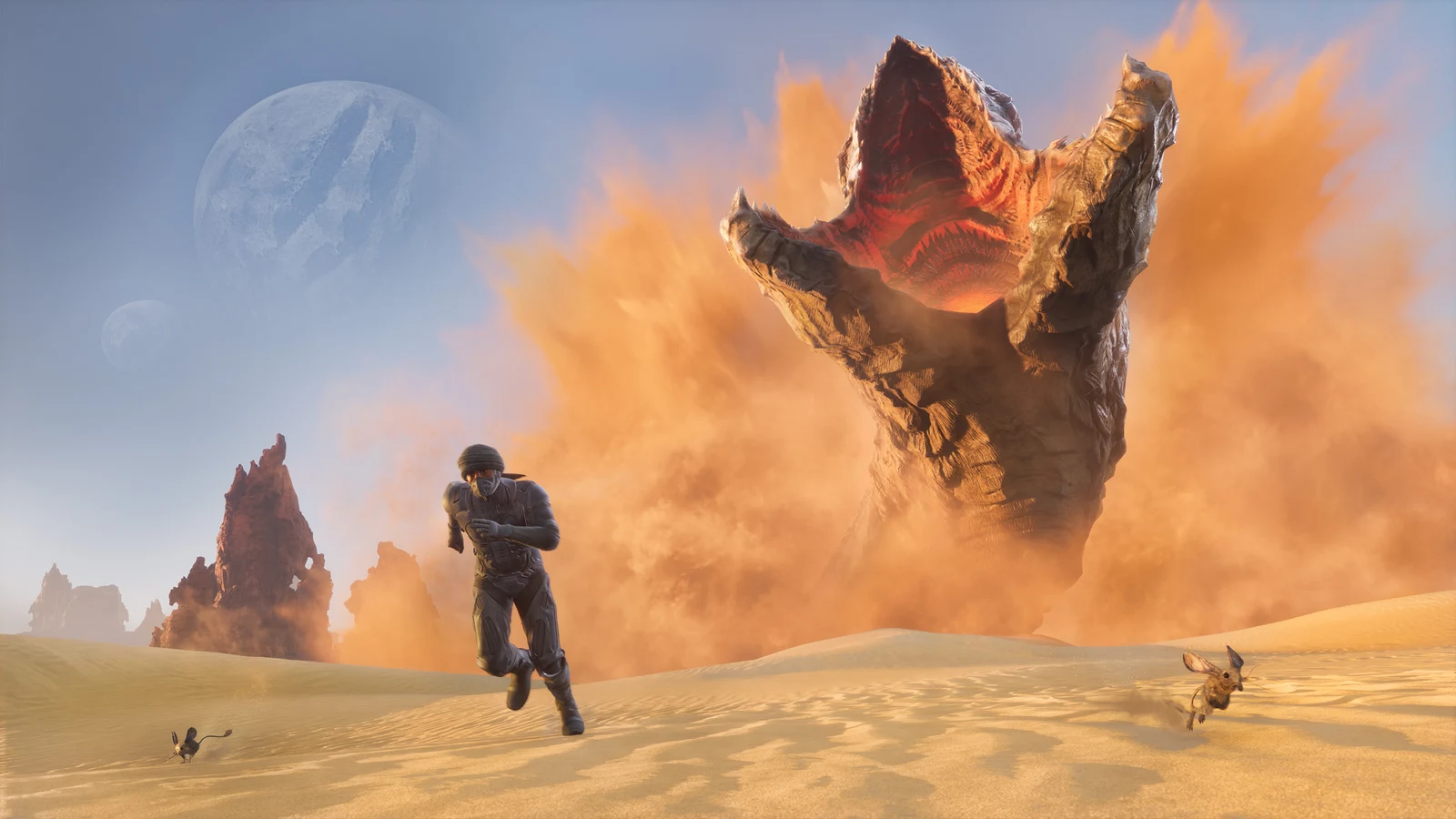
Yes — as of September 22, 2026, Dune: Awakening can be played entirely solo, on every platform it’s available on. Funcom’s own description: “the entire game can now be played solo. The story, the open world, the crafting, the Deep Desert, all of it.” That date is also when the game reaches consoles for the first time, launching on PS5 and Xbox Series X|S alongside the finale of the game’s Book One story.
What Single-Player Actually Means Here
Dune: Awakening isn’t being rebranded as a single-player game — Funcom’s own console announcement describes it as an open-world survival game inspired by Frank Herbert’s Dune, and it still supports large-scale multiplayer. What’s new is that none of the game is walled off from solo players anymore. Single-player mode ships with three preset difficulty levels plus manual customization: you can adjust harvesting rates, XP gain, combat difficulty, and toggle how destructive the Coriolis storms are. Two mechanics specific to solo play are worth knowing — bases in the Deep Desert aren’t wiped weekly the way they are on official servers, and a base reconstruction tool lets you save and restore full snapshots of your build, so you don’t lose progress the way multiplayer’s more punishing rules allow.
Single-Player vs. Private Servers vs. Official Servers
These are three different things, and Funcom’s own materials keep them separate:
- Single-player runs entirely on your own save, with the relaxed rules above, and no risk of other players raiding your base.
- Private servers let you play with a self-selected group — “just me and my friends” is how Funcom frames it — without opening your game to the wider public matchmaking pool.
- Official multiplayer servers are the full shared experience: optional PvE throughout, with dedicated PvP zones for players who want that competitive layer.
All three access the same story and Book One finale — Funcom isn’t gating the ending behind multiplayer participation.
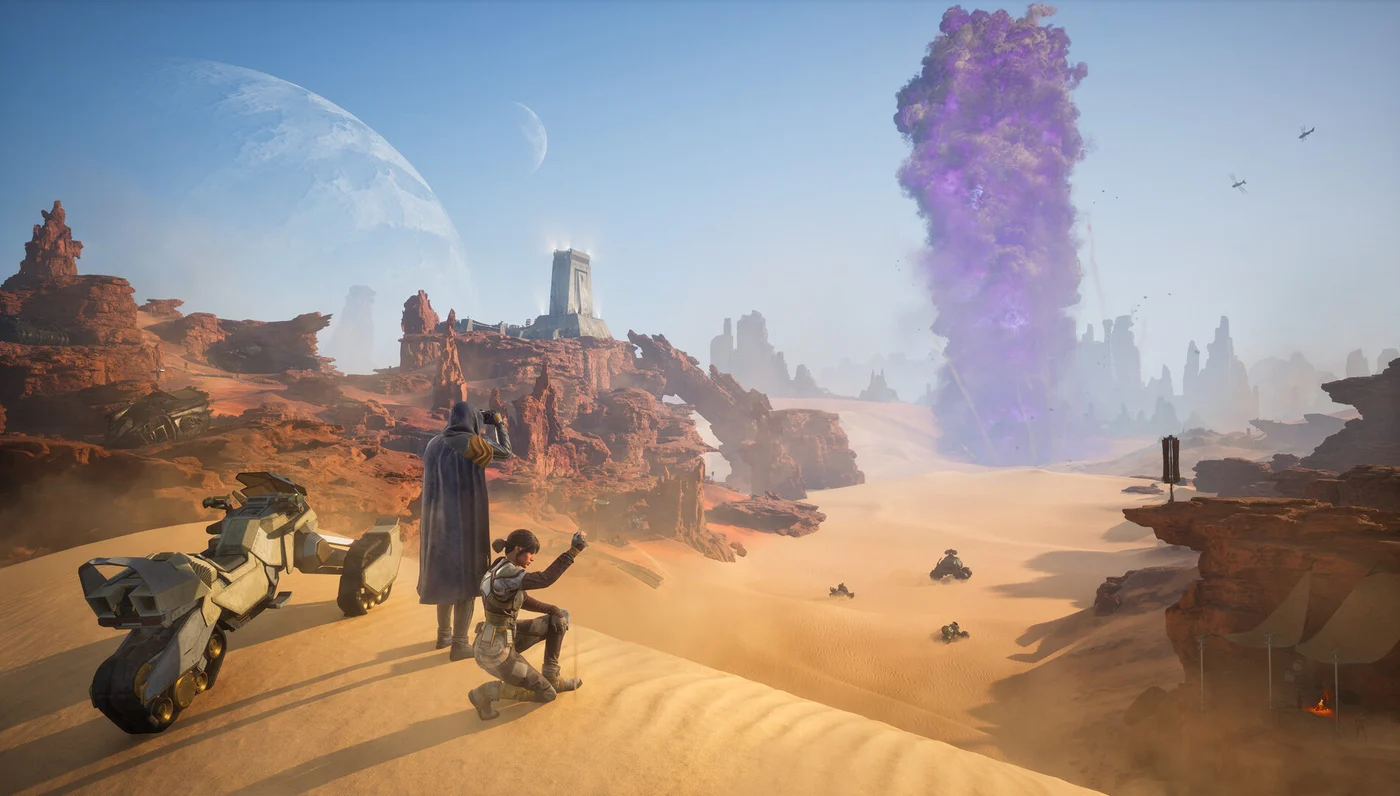
Official Dune: Awakening screenshot. Credit: Funcom / Bandai Namco.
What “Final Chapter of Book One” Means
Dune: Awakening has told its story in chapters since its original PC launch. The console release coincides with the last chapter of that first overarching arc — Funcom describes it as providing the complete story “from the opening cutscene to the final confrontation” for players jumping in fresh on console, while giving existing PC players who’ve followed along since launch its actual payoff. It’s the conclusion of Book One specifically, not a statement about the game’s story ending altogether.
Platforms, Editions and the Xbox-Specific Details
Dune: Awakening launches on PS5, Xbox Series X|S, and PC, with additional support for Steam Deck, ROG Xbox Ally, and GeForce Now. Three editions are available: Standard ($49.99), Deluxe ($69.99, adding a Season Pass with four DLCs plus 5-day early access starting September 17), and Ultimate ($89.99, adding four more DLCs plus extra cosmetics, building sets, an artbook and soundtrack).
On Xbox specifically, the game launches day one on Xbox Game Pass and as an Xbox Play Anywhere title, meaning progress and purchases carry over between Xbox consoles and the Microsoft Store PC version. That cross-play and cross-save link is currently limited to Xbox and Microsoft Store PC — it does not extend to Steam or PlayStation at launch. Funcom has confirmed full cross-play across PC, PlayStation and Xbox is planned for a later date, without giving a specific timeline yet.
Survival Basics: Shade, Water and Sandworms
Arrakis is unforgiving before you’ve unlocked much gear, and the same core survival loop applies whether you’re playing solo, on a private server, or in official multiplayer. Heat is the first thing that will kill you — direct sun drains hydration fast and can trigger Sunstroke, which worsens water loss and saps your stamina recovery until you find shade or shelter. Caves, cliffs, and heat-resistant gear all help; treat water and shade as your two most important early resources, well ahead of combat gear.
Sandworms are the other constant threat. They’re drawn to rhythmic movement on open sand, can’t be killed, and being caught by one means losing everything in your backpack. A vibration meter tracks how much noise you’re making and warns you as a worm closes in — the safest early habit is to avoid running in straight lines across open dunes and to watch that meter rather than the horizon.
Crafting, Bases and Vehicles
Base-building and crafting form the game’s long-term progression loop. You’ll gather raw materials to construct a base, then use crafting stations within it to build better gear, vehicles, and eventually the tools needed to survive deeper into the map. Vehicles matter for both speed and safety — they let you cross open sand faster than sandworms can react, which becomes essential once you start venturing beyond the early safe zones.
Spice is Arrakis’s signature resource and the reason the Deep Desert exists as a distinct late-game space. You don’t need to push into the Deep Desert early; lower-tier gear and materials are available through normal exploration and the player market, so it’s reasonable to hold off until you’ve built up a base and better equipment before risking spice runs in more dangerous, more contested territory.
Schools and Factions
Character progression is organized around five Schools: Trooper, Mentat, Swordmaster, Bene Gesserit, and Planetologist. Each has its own basic and advanced trainers, unlocked through in-world questlines rather than a simple level-up screen, and the game supports multiclassing across them rather than locking you into one permanently. Broadly: Trooper is the balanced offense/defense option, Swordmaster leans into melee damage and blocking, Mentat focuses on tactical and ranged play, Bene Gesserit emphasizes agility and control-oriented abilities, and Planetologist is built around resource gathering and exploration-focused play. None of that changes based on platform — console players are working with the same five Schools PC players have had since launch.
Faction standing runs through the Landsraad system, which assigns rotating weekly objectives — crafting specific items, harvesting particular resources, and similar goals — that earn votes toward faction outcomes. It’s a good system to pay attention to once you’re past the earliest survival hurdles, but not something a brand-new player needs to prioritize in the first few hours.
The Filmic Archive DLC
Alongside the console launch, Funcom is releasing the Filmic Archive DLC on September 22 for PC, Xbox and PS5, priced at $9.99. It’s cosmetic rather than mechanical: outfits and gear inspired by Denis Villeneuve’s Dune films, including the Aegis of the Unwalked Path armor drawn from Paul Atreides’ Fremen visions in Dune: Part One and the Caladan Stormcoat worn by Paul and Duke Leto, plus a 73-piece base-building set styled after the Sardaukar. It’s entirely optional — nothing in the base console release requires it, and it doesn’t gate any story or survival content.
What We Still Don’t Know
Funcom hasn’t given an exact date for full cross-platform play beyond “planned for later,” hasn’t detailed what happens to the game’s story structure after Book One concludes, and hasn’t confirmed whether private servers will be available on console the way they are on PC. Treat those as open questions rather than assumptions either way.
For more on the Dune franchise’s screen side, see our coverage of Dune: Part Three’s early IMAX screenings and our breakdown of what Dune Messiah’s adaptation actually changes. For more upcoming games, visit our Gaming hub.
Sources
- Xbox Wire — Dune: Awakening Is Coming to XBOX on September 22 — June 4, 2026
- Level Infinite — Dune: Awakening comes to PS5 and Xbox on September 22 — June 2, 2026
- Dune: Awakening (official) — Console Date and Single-Player Announced — June 2, 2026
- Dune: Awakening (official) — Gamescom: Console Gameplay, Filmic Archive DLC, and Cross-Play Confirmed for Post Launch
- Bandai Namco Europe (YouTube) — Dune: Awakening | Console Announcement Trailer
- Dune: Awakening (official) — Gamescom Recap — August 26, 2026
Make Red Reactions a preferred source
Choose Red Reactions as a preferred source in Google Search.
Confirm your choice on Google.
Related coverage
Dune Messiah Explained: What Dune: Part Three Is Actually Adapting
Dune: Part Three is based on Frank Herbert's Dune Messiah, the novel where Paul's victory becomes the problem. Here's what the book actually does, and what the film has confirmed so far.

Dune: Part Three Sets Early IMAX 70mm Screenings Before December Release
Dune: Part Three will screen early in select IMAX 70mm theaters on December 14, while its regular North American release remains December 18.
Metal Gear Solid 4 Is Finally Free From the PS3 After 18 Years
Metal Gear Solid: Master Collection Vol. 2 brings Metal Gear Solid 4: Guns of the Patriots to PS5, Xbox, Steam and Switch, ending 18 years of PS3 exclusivity.

PS5 QSSR: Supported Games, How to Use It, and QSSR vs PSSR
QSSR brings AI upscaling to standard PS5. See Sony-confirmed games, how to find their graphics options and how QSSR differs from PS5 Pro PSSR.
About the author
Bamo Anwar
Anime & Gaming Writer
Bamo Anwar covers anime and gaming for Red Reactions. His work ranges from release news and detailed trailer breakdowns to beginner guides, watch orders and explainers designed to make large franchises and game systems easier to enter.
Coverage: Anime · Gaming · Beginner Guides · Watch Orders · Explainers
More from Bamo Anwar