feature · comics / movies
Spider-Man: Brand New Day Comics Reading Guide — What to Read After the Movie
The movie borrowed its name from a real Spider-Man comics era. Here's where that era actually starts, what changed, and the short reading route worth following instead of all 101 issues.
 By Aram Anwar9 min read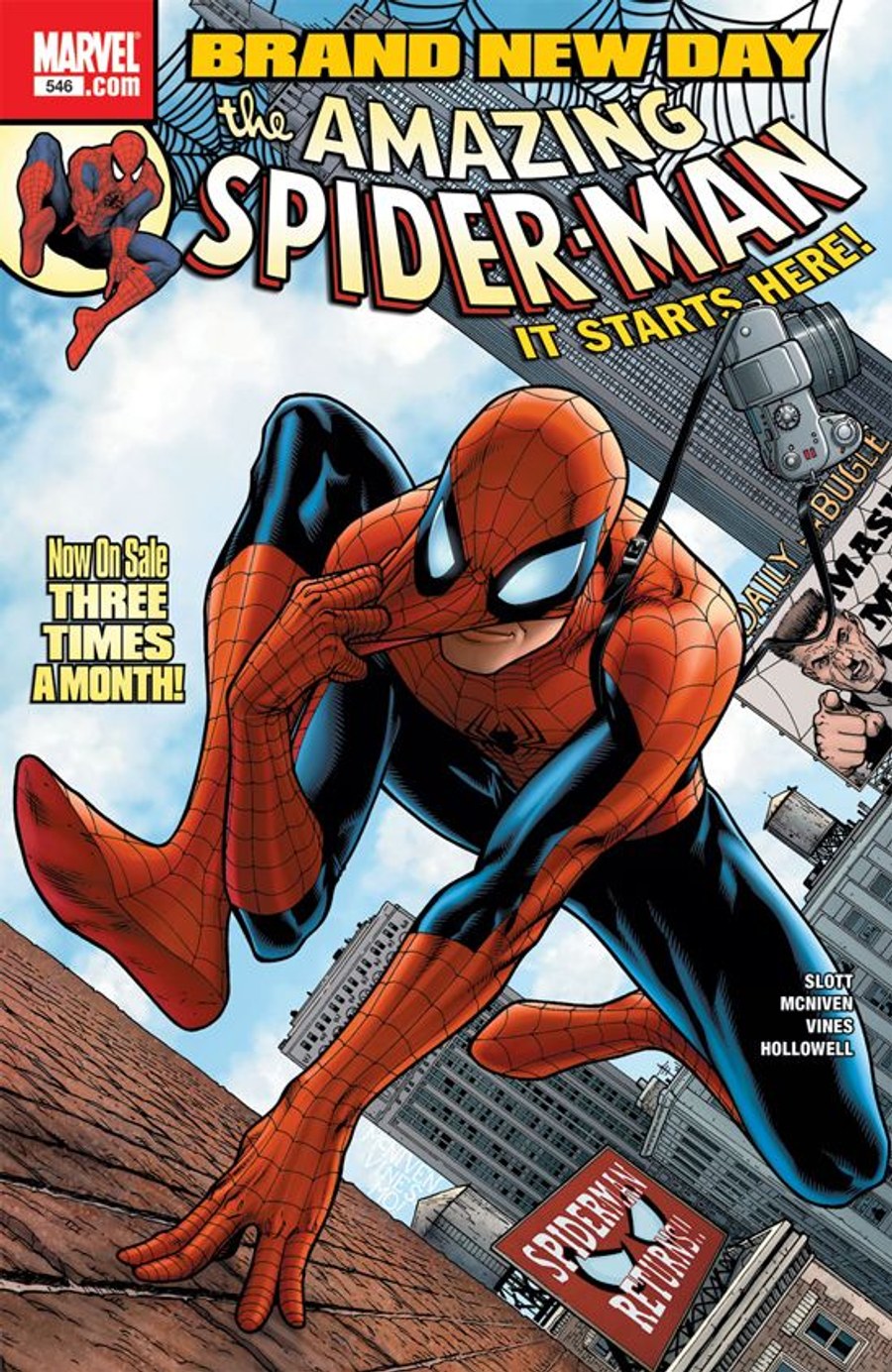
Spider-Man: Brand New Day took its title from a real comics era, and that’s about as far as the connection goes on its own — the film doesn’t adapt that story. With the movie now past Avengers: Endgame’s domestic total and sitting behind only Star Wars: The Force Awakens on the all-time chart, a lot of people are searching for the comics that share its name. Here’s what that era actually is, where it starts, and what’s actually worth reading out of it.
Start here: The Amazing Spider-Man #546, released January 2008. Marvel built it as a jumping-on point on purpose — double-sized, with backup stories introducing the new supporting cast — and you don’t need anything published before it to follow along.
Do you need to read One More Day first?
No, not really. “One More Day” is the four-part story that precedes Brand New Day and explains how Peter Parker ended up here — it ran across The Amazing Spider-Man #544 and #545, Friendly Neighborhood Spider-Man #24 and The Sensational Spider-Man (vol. 2) #41 in late 2007. In it, Peter and Mary Jane make a deal with the demon Mephisto: their marriage is erased from history in exchange for saving Aunt May’s life.
You don’t need to watch that deal happen to understand Brand New Day. ASM #546 recaps the changed status quo cleanly enough for a new reader. If you’re the type who wants the full “why,” go back and read it — otherwise, treat it as prior context, not a prerequisite.
What actually changed
Brand New Day isn’t a new character or a new costume. It’s a full status-quo reset, and Marvel was explicit about the pieces:
- Peter’s secret identity is restored. Everyone who learned it during Civil War has forgotten it, as part of the same Mephisto deal.
- The marriage is gone. Peter and Mary Jane are no longer married, and haven’t been for years in the story’s internal history — this is the change “One More Day” made, not something Brand New Day itself undoes further.
- Peter is broke and single again, working freelance photography for a Daily Bugle that’s changed hands — new owner Dexter Bennett renamed it “the DB” and runs it as a tabloid.
- Harry Osborn is alive and back in New York after years in Europe, which matters because Harry had been treated as dead for a long stretch of Spider-Man history.
- A new supporting cast takes root, most notably Carlie Cooper, a police forensics tech who becomes a recurring love interest.
- New villains debut, starting with Mr. Negative — a Chinatown businessman with a corrupting light-and-dark power set who’s introduced directly in #546 — and continuing with Menace, a Green Goblin-style glider-riding villain whose civilian identity is one of the era’s central mysteries.
- Jackpot, a new hero with a mysterious identity, also debuts during this stretch.
- The book itself changed shape. Instead of one writer on a monthly schedule, Marvel published Amazing Spider-Man three times a month with a rotating team — Dan Slott, Marc Guggenheim, Bob Gale and Zeb Wells as the core rotating writers, with artists including Steve McNiven, Salvador Larroca, Phil Jimenez, Chris Bachalo, Marcos Martin and Barry Kitson — producing shorter, faster-moving arcs instead of long single-writer sagas.
Be careful with one distinction: not everything that shows up during Brand New Day originated there. Villains like Vulture, Chameleon and Rhino also appear during this stretch, but they’re pre-existing Spider-Man characters getting new material, not new creations of this era the way Mr. Negative and Menace are.
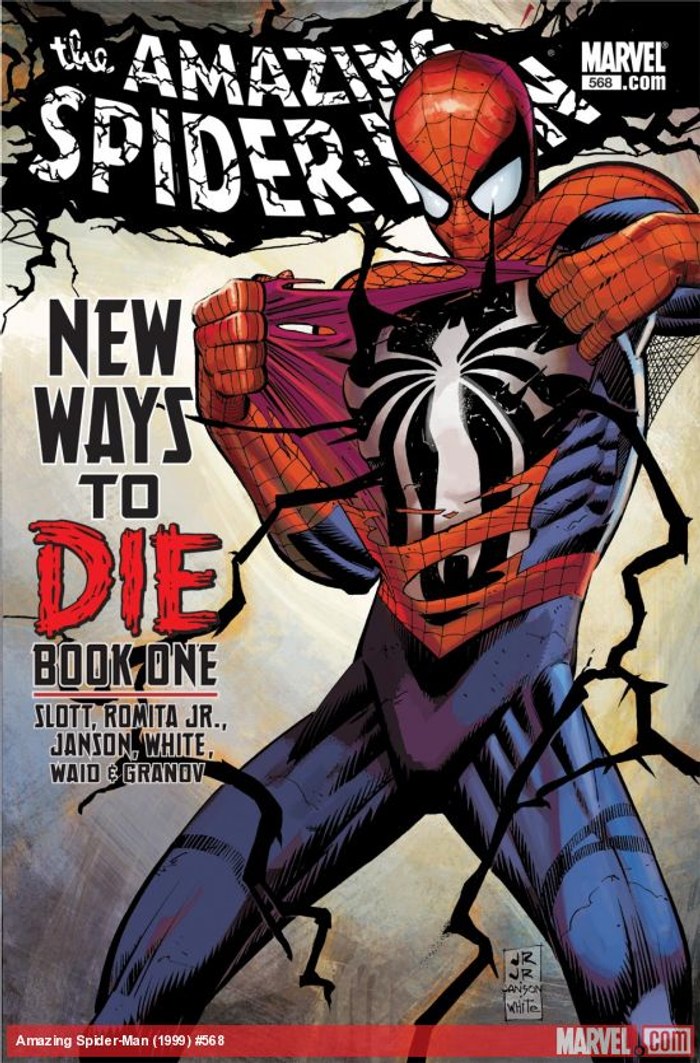
New Ways to Die is where Mr. Negative’s setup from #546 actually pays off. Credit: Marvel.
The short essential reading route
You don’t need all 101 issues. This gets you the actual shape of the era:
| Story | Issues | Why read it | Essential? |
|---|---|---|---|
| Opening arc | ASM #546 onward | Introduces Mr. Negative and the new status quo | Start here |
| New Ways to Die | ASM #568–573 | Mr. Negative’s plan pays off; introduces Anti-Venom | Essential |
| Character Assassination | ASM #584–588 | Unmasks Menace — sets up American Son directly | Essential |
| American Son | ASM #595–599 | Harry Osborn’s return comes to a head | Essential |
| Grim Hunt | ASM #634–637 | The Kravinoff family arc; a real turning point for a longtime supporting character | Essential |
| Origin of the Species / #647 | ASM #642–647 | The era’s actual finale | Essential |
| One Moment in Time | ASM #638–641 | Retroactively explains “One More Day“‘s mechanics | Optional |
| Rest of “The Gauntlet” | ASM #611–633 (minus Grim Hunt) | Villain-of-the-month issues building tension before Grim Hunt | Worth reading, not required |
Character Assassination isn’t skippable if you’re reading American Son — it’s where Menace’s identity comes out, and American Son assumes you already know it. Everything marked “optional” or “worth reading” can be skipped without losing the throughline; “One Moment in Time” specifically is a 2010 clarification of what changed in “One More Day,” written for readers who wanted more detail on that deal rather than for people following the main plot forward.
Where Brand New Day ends
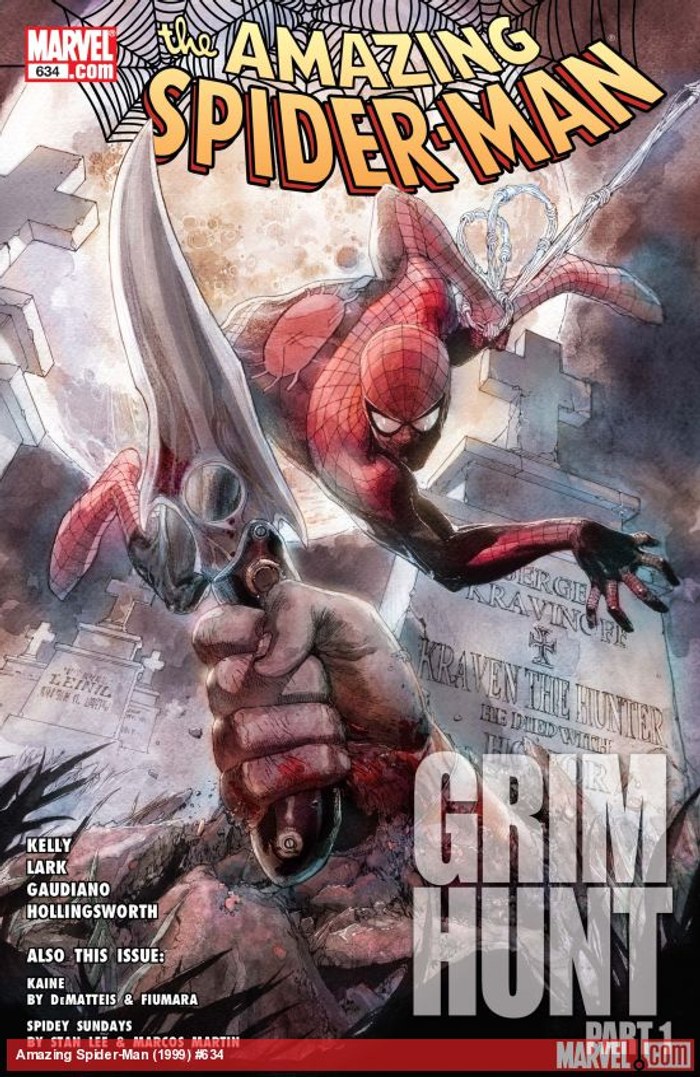
Grim Hunt is the closest thing this era has to a genuine turning point for its supporting cast. Credit: Marvel.
Marvel’s own solicitation for the finale put it plainly: “After 101 issues,” the era wraps up in The Amazing Spider-Man #647, a triple-sized issue published in late 2010. The very next issue, #648, opens a new stretch of the book branded “Big Time” — Dan Slott takes over as solo regular writer, Peter lands a job at Horizon Labs, and the three-times-a-month publishing pace that defined Brand New Day ends with it. You don’t need to read Big Time to understand Brand New Day; it’s a genuinely separate next chapter, not a continuation of the same arcs.
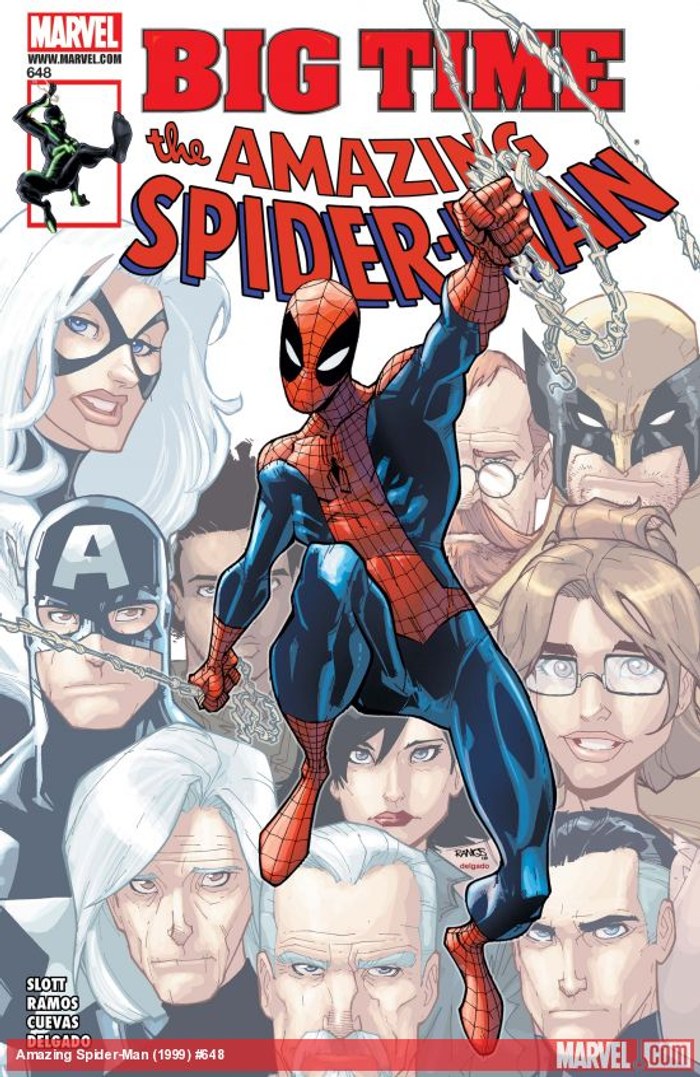
ASM #648 — the very next issue after Brand New Day ends, and the start of a different chapter. Credit: Marvel.
Want a fuller route instead?
If you want to read the complete 101-issue stretch rather than the shortlist above, existing Marvel Unlimited members retain reading access until December 7, 2026; new signups closed October 5. Our Marvel Comics app guide explains the transition. Marvel maintains its own official Brand New Day reading list if you want every fill-in issue accounted for. This guide exists specifically to cut that down to what a newcomer actually needs — not to reproduce Marvel’s own list.
Is the Marvel Compact a complete Brand New Day collection?
No. Spider-Man: Brand New Day [Marvel Compact] is a selection of stories from the era, not the complete #546–647 run or a collected version of the essential route above. Choose it for a shorter introduction to the rotating creative teams; follow the issue guide if you want the main arcs in sequence.
The publisher’s contents include the Spider-Man/Wolverine snowstorm story Sometimes It Snows in April, Flash Thompson’s Flashbacks and the subway rescue Unscheduled Stop. That mix gives you different kinds of Spider-Man stories without asking you to buy the entire era. It does not replace a full run when a particular character’s development is your reason for reading.
| What you want | Which route fits |
|---|---|
| A single paperback sampling the era | Marvel Compact: selected stories, with gaps between them |
| The major arcs and their setup | The essential issue route above |
| Every issue in publication order | The complete #546–647 stretch, beyond what the Compact collects |
For identifying the print edition, Penguin Random House lists ISBN 9781302968663, 328 pages and a June 2, 2026 US publication date. Its US publisher list price was $9.99 when checked October 11, 2026; that is a dated catalog figure, not a current Amazon price or a promise about shipping or availability.
For the film’s home-viewing options, use our separate Brand New Day digital release guide.
The 2026 movie’s title, not its plot
Sony and Marvel Studios have not described Spider-Man: Brand New Day as an adaptation of this comics era, and nothing here should be read as claiming otherwise. The film borrows the name and, broadly, the idea of a reset — a Peter Parker figuring out a changed version of his life — but specific plot points, villains and supporting characters in the movie shouldn’t be assumed to come from the 2008–2010 comics just because they share a title or a rough tone. Any given connection between the film and this era is worth checking individually rather than assuming.
Want a current Brand New Day comic instead?
Marvel is also currently publishing Spectacular Spider-Man: Brand New Day, a new series that began with #1 on May 13, 2026. It’s written by Dan Slott — one of the original 2008–2010 era’s core writers — with art by Marcus To and backup stories by Marcos Martin, another Brand New Day veteran. Marvel’s own description frames it as “an all-new story building upon their 2008–2010 era,” centered on Spider-Man going after a criminal ledger called the Lexicon that both Kingpin and a returning Mr. Negative want control of.
This is worth being precise about: it’s not a comic adaptation of the movie, and Marvel hasn’t presented it that way. It’s a new, ongoing story by veterans of the original comics era, using the same branding and some of the same villains — a reasonable pick if you want something currently on shelves with a real creative link to 2008–2010, but not a way to “read the movie” in comic form.
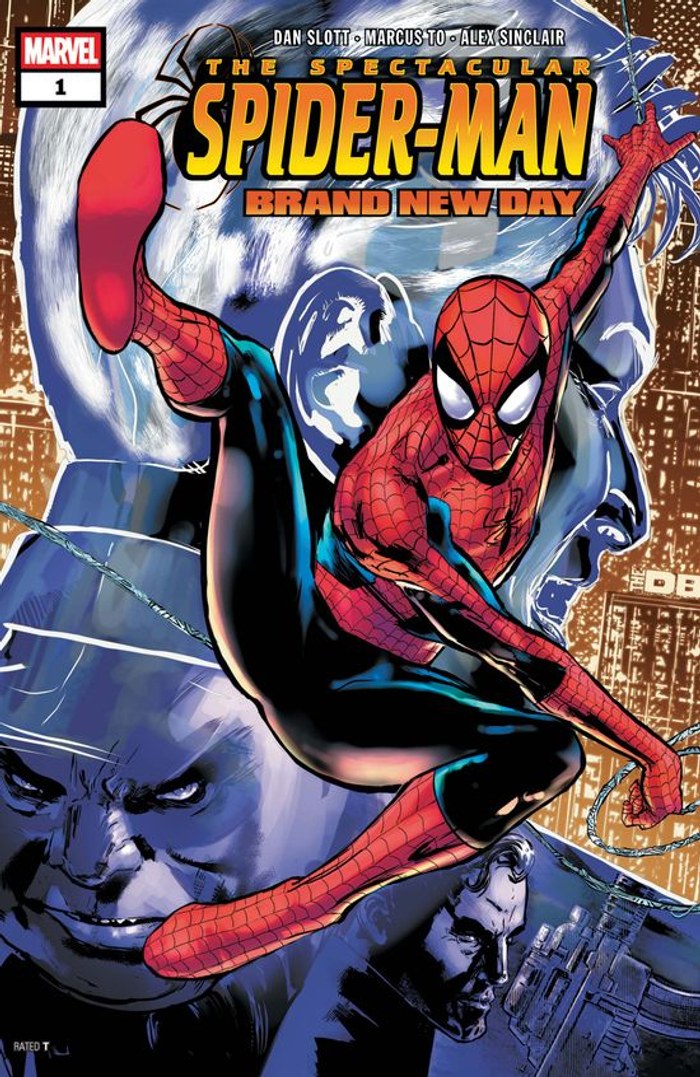
Spectacular Spider-Man: Brand New Day #1 (2026) — a new story from original-era veterans, not a movie tie-in. Credit: Marvel.
The short version
Start with Amazing Spider-Man #546. Skip “One More Day” unless you want the deeper context. Read New Ways to Die, Character Assassination, American Son, Grim Hunt and the Origin of the Species/#647 finale for the actual shape of the era. Stop at #647 — Big Time is its own thing. And treat the movie’s title as a title, not a spoiler for which comic you’re about to read.
For more on how Brand New Day is performing at the box office, see our coverage of the film passing Avengers: Endgame on its way toward The Force Awakens and its record-setting climb past $700 million domestically.
Sources
Make Red Reactions a preferred source
Choose Red Reactions as a preferred source in Google Search.
Confirm your choice on Google.
Related coverage
Amazing Spider-Man #1000 Is Out Now — Story Lineup and Second Printing
Amazing Spider-Man #1000 is out now with Joe Kelly and Pepe Larraz's lead story, seven anniversary tales, Noah Hawley's debut and an October second printing.
Your Friendly Neighborhood Spider-Man Gets a Canon Comic Bridge Before Season 2
Marvel's new four-issue Your Friendly Neighborhood Spider-Man comic connects Seasons 1 and 2, with Christos Gage and Eric Gapstur returning.
Spider-Man: Brand New Day Passes $2 Billion Worldwide
Spider-Man: Brand New Day has crossed $2 billion worldwide, becoming only the eighth film ever and the second-fastest to reach the milestone.
DC/Marvel Crossover Reading Order: From Superman vs. Spider-Man to JLA/Avengers and the 2026 Crossovers
The practical DC/Marvel crossover reading order: the original 1976 team-up, DC vs. Marvel, Amalgam Comics, JLA/Avengers, and the 2025–26 revival, organized by era instead of one invented continuity.
About the author
Aram Anwar
Founder & Editor
Aram Anwar founded Red Reactions and writes across comics, gaming, movies and television. His work includes franchise guides and large Lore / Explained features, with an emphasis on separating confirmed details from reports, theory and speculation.
Coverage: Comics · DC & Marvel · Gaming · Movies & TV · Lore / Explained · Guides
More from Aram Anwar